Willibaldsburg
Eichstätt
Visit
Hours to be confirmed
You are leaving for the château’s own website
See guided tours and skip-the-line tickets tooTickets via our partner GetYourGuide, affiliate link
Tickets and prices
- Adult
- €6
- Child
- Free
- Reduced
- €5
Free for Children and young people up to the age of 18
- Where
- Eichstätt
Hours and prices not verified at the source yet.Check on the official website
To make a day of it
Open within 20 km
Willibaldsburg stands in Eichstätt (Landkreis Eichstätt), in Bavaria, Germany. The building is a listed Baudenkmal. Recorded dating: 11th century. Adult admission costs 6 EUR. Its opening hours and prices have not been verified at the source yet.
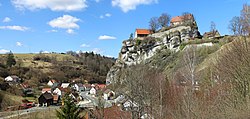
The Willibaldsburg stands on a rocky spur above the Altmühl valley, just west of the old town of Eichstätt. Construction began in the mid 14th century as a fortified residence for the prince-bishops of Eichstätt, and the complex grew over the centuries into a Renaissance palace designed by the Augsburg architect Elias Holl for Bishop Johann Konrad von Gemmingen. Visitors today can see the 17th century bastions, the twin-towered facade of the Gemmingenbau, and the remains of the botanical garden that inspired the famous Hortus Eystettensis. The buildings now house museums devoted to natural history and regional prehistory.
Written from Willibaldsburg
What to know
- The site sits on a rocky spur above Eichstätt, so reaching it involves a climb from the valley or the old town.
- The fortress now houses the Jura-Museum, dedicated to regional fossils including the Eichstätt Archaeopteryx.
- A museum of prehistory and a reconstructed bastion garden are also part of the visit.
- A circular path allows visitors to walk around the entire fortified complex.
- The monument is listed as a Baudenkmal in Bavaria.
Practical information
Opening hours
- April-3 October
- 9-18 Uhr
- 4 October-March
- 10-16 Uhr
Annual closures : 1 January, Mardi Gras, 24, 25 and 31 December, every Monday (except public holidays)
Prices
- Adult
- €6
- Child
- Free
- Reduced
- €5
Free for Children and young people up to the age of 18
- Visit duration
- Not verified
- Wheelchair access
- Not verified
- Dogs
- Not verified
- Parking
- Parking available in the Vorburg and at the vocational school car park on Burgstraße. No bus parking.
On site
- Food and drink
Where this château is
Eichstätt · Landkreis Eichstätt · Bayern
Loading the map…
This châteauChâteaux within 40 km
Address
Burgstraße 19, 85072 Eichstätt
Directions open from wherever you are, by car or public transport.
The safest check before setting off: today’s hours, guided-tour availability, where to park.
4.4 / 5from 856 Google reviews
- Heritage status
- Baudenkmal in Bayern
- Period of construction
- 11th century
Base map © IGN, Géoplateforme
In pictures
Frequently asked
- Willibaldsburg: how much is admission?
- Adult admission is €6. Child: free. Reduced: €5. Free for: children and young people up to the age of 18.
- Who built the Willibaldsburg?
- Bishop Berthold von Zollern began its development around 1355 as a fortified residence for the bishops of Eichstätt.
- What can visitors see at the Willibaldsburg today?
- Visitors can explore the Jura-Museum with its fossil collection, a museum of prehistory, and a reconstructed bastion garden.
- Why is the Willibaldsburg linked to Elias Holl?
- This Augsburg architect designed the Renaissance palace built from 1609 for Bishop Johann Konrad von Gemmingen.
- Was the Willibaldsburg involved in any battles?
- Yes, it was captured by a Swedish army in 1633 and retaken by Bavarian troops the same year.
Something wrong here?
Tell us. Every report moves this entry up our verification queue.
Sources
Identity, location and official references from Wikidata and the Land's heritage lists.
Within an hour’s drive
 Residenz EichstättEichstätt · Landkreis Eichstätt
- Burgstall ObereichstättDollnstein · Landkreis Eichstätt
 Burg Dollnstein (Dollnstein Castle)Dollnstein · Landkreis Eichstätt
 Schloss Inching (Inching Castle)Walting · Landkreis Eichstätt
 Burgruine AdlersteinWellheim · Landkreis Eichstätt
 Burg Krugsburg (Krugsburg Castle)Mörnsheim · Landkreis Eichstätt