Burgstall Queckborn
Queckborn
Access
No visits on recordNo opening hours or ticketing found
- Where
- Queckborn
To make a day of it
Open within 20 km
Burgstall Queckborn stands in Queckborn (Landkreis Gießen), in Hesse, Germany. No visits are on record for this building.
The Burgstall Queckborn marks the site of a former fortification, now vanished, which once stood where the village church of Queckborn, a district of Grünberg, stands today. Built probably in the 12th century by the lords of Queckborn, it passed around 1380 to the lords of Strebekoz before being destroyed or converted into a church around 1450. Walled-up Romanesque arches in the present building and foundation remains uncovered in the 19th century, including the base of a round tower, still bear witness to this fortified origin.
What to know
- No visible structure of the original fortification remains; only its location, now occupied by the village church, preserves its memory.
- The last remaining wall fragments were demolished in 1830.
- Walled-up Romanesque arches in the current building and foundations of a round tower found in the 19th century are the only archaeological traces left.
- The site is located in Queckborn, a district of Grünberg, in the Landkreis Gießen, Hesse.
Where this château is
Queckborn · Landkreis Gießen · Hessen
Loading the map…
This châteauChâteaux within 40 km
Address
35305 Grünberg
Directions open from wherever you are, by car or public transport.
- Heritage status
- Protection status unknown
Base map © IGN, Géoplateforme
Frequently asked
- Can the Burg Queckborn still be seen today?
- No, the fortification has vanished and its site is now occupied by the village church, with only walled-up Romanesque arches and foundation remains as traces.
- Who built this fortification?
- It was probably built in the 12th century by the lords of Queckborn, first mentioned in 1108.
- What remains of the original structure?
- Walled-up Romanesque arches within the present church and foundation remains, including those of a round tower, uncovered in the 19th century.
- When did the last remains disappear?
- The last standing wall fragments were demolished in 1830.
Something wrong here?
Tell us. Every report moves this entry up our verification queue.
Sources
Identity, location and official references from Wikidata and the Land's heritage lists.
Within an hour’s drive
 Burgstall GrünbergGrünberg · Landkreis Gießen
- Burgstall LauterLauter (Laubach) · Landkreis Gießen
 Burg Wirberg (Wirberg Castle)Wirberg · Landkreis Gießen
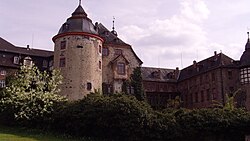 Schloss Laubach (Laubach Castle)Laubach · Landkreis Gießen
 Burg Winnerod (Winnerod Castle)Winnerod · Landkreis Gießen
- Burgstall ReiskirchenReiskirchen · Landkreis Gießen


