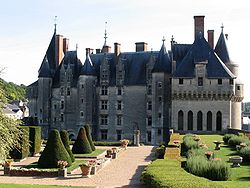
Château de Lurais
Lurais Castle
Lurais
Access
Not open to visitors
Privately owned, not open to visitors.
Source: Parc naturel régional de la Brenne, courriel du 20 septembre 2026
- Where
- Lurais
To make a day of it
Open within 20 km
- Château d'Angles-sur-l'Anglin (Angles-sur-l'Anglin Castle)from €7.505 km
- Château du Bouchet (Indre)28 March to 30 April, Wednesday to Sunday and public holidays; 1 May to 28 June, Wednesday to Sunday and public holidays; 1 July to 31 August, Tuesday to Sunday and public holidays; 2 September to 31 October, Wednesday to Sunday and public holidays; 1 November to 8 November, Wednesday to Sunday and public holidays (closed on Friday)17 km
- Château d'Azay-le-FerronOpen to visitors19 km
Château de Lurais stands in Lurais (Indre), in the Centre-Val de Loire region of France. The building is registered as a historic monument (dating recorded in the Mérimée database: 15th century). The building is not open to visitors.
Built on the foundations of a 13th-century priory dependent on the abbey of Saint-Cyprien in Poitiers, Lurais castle embodies the transformation of monastic space into a fortified residence during the late Middle Ages. This 14th and 15th-century structure, organised around a central block with corner towers, bears the marks of time: the loss of its south-west tower and the cutting down of its upper storeys. Its vaulted cellars and small oratory preserve traces of its religious origins.
What to know
- The castle contains both private spaces and communal rooms, including a 15th-century oratory with ogival vaults and cellars extending beneath the structure.
- Listed as a historic monument since 1987, the protection covers facades, roofs, cellars, spiral stairs and vaulted interior features, but excludes the 19th-century addition on the south side.
- No public information is available regarding visiting conditions or opening hours.
Where this château is
Lurais · Indre · Centre-Val de Loire
Loading the map…
This châteauChâteaux within 40 km
Address
36220 Lurais
Directions open from wherever you are, by car or public transport.
- Period of construction
- 15th century
Base map © IGN, Géoplateforme
Frequently asked
- When was the castle fortified?
- The transformation of the priory dwelling into a fortified residence took place in the late 15th or early 16th century, though the building itself dates from the 14th and 15th centuries.
- What can be visited inside?
- The communal section includes a small vaulted oratory on the third level and a spiral staircase at garden level. The cellars beneath the entire castle and certain ogival-vaulted rooms are included in the listed protection.
- How did the castle change its purpose over time?
- After serving as an abbatial residence for two centuries, the castle became a farm around 1700. Sold as national property during the Revolution, it was divided in the 19th century, when a new building was constructed against its southern wall.
Something wrong here?
Tell us. Every report moves this entry up our verification queue.
Sources
Identity, location and official references from Wikidata and the Mérimée register.
- This entry in Markdown
- Wikidata Q22940982
- Mérimée PA00097383
Within an hour’s drive
 Château du Soudun (Soudun Castle)Néons-sur-Creuse · Indre
- Château de la Ridelière (Ridelière Castle)Lurais · Indre
 Manoir de Maison-NeuveTournon-Saint-Martin · Indre
 Château de la Brosse (Brosse Castle)Vicq-sur-Gartempe · Vienne
- Château de Monteneaux (Monteneaux Castle)Lurais · Indre
 Château de Néons-sur-Creuse (Néons-sur-Creuse Castle)Néons-sur-Creuse · Indre