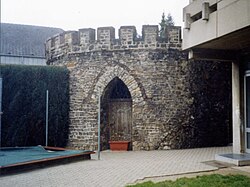
Burg Weisweiler
Weisweiler Castle
Eschweiler
Access
No visits on recordNo opening hours or ticketing found
- Where
- Eschweiler
To make a day of it
Open within 20 km
Burg Weisweiler stands in Eschweiler (Städteregion Aachen), in North Rhine-Westphalia, Germany. The building is a listed Baudenkmal. Recorded dating: 12th century. No visits are on record for this building.
Burg Weisweiler is a former moated stronghold founded in the 12th century in the Weisweiler district of Eschweiler, of which only fragmentary remains survive today. The rubble stone enclosure still visible, with its four semicircular towers and single round-arched gateway, actually dates from the 15th and 16th centuries. A former barn within the courtyard, converted into a church in the 18th century, is the only building to have survived intact. The grounds now also hold the Protestant Resurrection Church and a memorial cemetery.
What to know
- The site is an open-air ruin, centred on the surviving enclosure wall and towers.
- The barn converted into a church displays a small case of objects found on the castle grounds.
- The main buildings were lost after an earthquake in 1755, so only the wall and one outbuilding remain.
- No information on admission fees, opening hours or accessibility is available for this site.
- A parsonage occupied by the local pastor's family stands within the former castle grounds, limiting access to some areas.
Where this château is
Eschweiler · Städteregion Aachen · Nordrhein-Westfalen
Loading the map…
This châteauChâteaux within 40 km
Address
Eschweiler, Städteregion Aachen
Directions open from wherever you are, by car or public transport.
- Heritage status
- Baudenkmal in Nordrhein-Westfalen
- Period of construction
- 12th century
Base map © IGN, Géoplateforme
In pictures
Frequently asked
- Can Burg Weisweiler be visited?
- The outer remains, the wall and towers, can be seen, but part of the grounds is occupied by an inhabited parsonage.
- How old is Burg Weisweiler?
- Founded in the 12th century, its present appearance dates from a rebuilding in the 15th and 16th centuries.
- What survives of the castle today?
- A rubble stone enclosure with four semicircular towers and a former barn converted into a church.
- Why was the castle abandoned?
- An earthquake in 1755 destroyed the main building, leading to the demolition of the remaining structures.
Something wrong here?
Tell us. Every report moves this entry up our verification queue.
Sources
Identity, location and official references from Wikidata and the Land's heritage lists.