
Burg Stolpen
Stolpen Castle
Stolpen
Visit
Hours to be confirmed
You are leaving for the château’s own website
Tickets and prices
- Adult
- €8
- Child
- €1
- Reduced
- €7
Prices and tickets on the château’s website
Prices checked at the source on October 16, 2026
- Where
- Stolpen
To make a day of it
Open within 20 km
Burg Stolpen stands in Stolpen (Landkreis Sächsische Schweiz-Osterzgebirge), in Saxony, Germany. The building is a listed Baudenkmal. Recorded dating: 12th century. Adult admission costs 8 EUR. Its opening hours and prices were verified at the source on October 16, 2026.
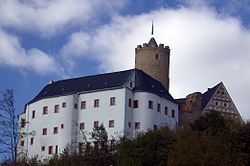
Burg Stolpen stands on a basalt outcrop east of Dresden, right in the middle of the small town of Stolpen in Saxony. For almost three centuries it served as one of the main residences of the bishops of Meissen, before passing to the Wettin princes, who turned it into a fortified Renaissance stronghold. The site owes much of its fame to Countess Cosel, former mistress of Augustus the Strong, who was held captive here for nearly fifty years. Visitors can still see the medieval towers, the fortified remains and the bare volcanic rock supporting the whole complex.
What to know
- The site is partly ruined, combining preserved buildings with open-air remains.
- The ground is sloped and rocky, requiring reasonable mobility to move between the towers.
- The basalt hill itself is part of the visit, with rock formations visible on the western side.
- The connection to Countess Cosel, held prisoner on site, is one of the main historical points of interest.
- The castle stands right in the centre of the town of Stolpen, within easy walking distance.
Practical information
Opening hours
- 30 mars 2026 au 25 octobre 2026
- 10h00-18h00 (tous les jours)
- 26 octobre 2026 au 08 novembre 2026
- 10h00-16h00 (tous les jours)
- 09 novembre 2026 au 28 février 2027
- fermé du lundi au vendredi, samedi et dimanche 10h00-16h00 (ouvert également certains jours fériés et vacances : 18.11.2026, 23 et 26-30.12.2026, 01.01.2027, 06-21.02.2027)
- en hiver, entre le 1er novembre et le 31 mars, ouverture dépendante des conditions météorologiques
Annual closures : 24.12.2026; 25.12.2026; 31.12.2026
Prices
- Adult
- €8
- Child
- €1
- Reduced
- €7
- Visit duration
- Not verified
- Wheelchair access
- Not verified
- Dogs
- Allowed in the grounds
- Parking
- Parking spaces on the market square (with parking disc, max. 2 h) and at the Ärztehaus and Schützenhausstraße stops
On site
- Child-friendly
Where this château is
Stolpen · Landkreis Sächsische Schweiz-Osterzgebirge · Sachsen
Loading the map…
This châteauChâteaux within 40 km
Address
Stolpen, Landkreis Sächsische Schweiz-Osterzgebirge
Directions open from wherever you are, by car or public transport.
- Heritage status
- Kulturdenkmal in Sachsen
- Period of construction
- 12th century
Base map © IGN, Géoplateforme
In pictures
Frequently asked
- Burg Stolpen: how much is admission?
- Adult admission is €8. Child: €1. Reduced: €7.
- Who built Burg Stolpen?
- The first fortifications date to around 1100, and the bishops of Meissen built and expanded the castle from the early 13th century onward.
- Why is Burg Stolpen famous?
- It is best known as the place where Countess Cosel, former mistress of Augustus the Strong, was held captive for nearly fifty years.
- Is Burg Stolpen a ruin?
- Part of the buildings are preserved while other sections are ruined, notably following destruction during the Napoleonic wars.
- Where is Burg Stolpen located?
- It stands in Stolpen, in the Landkreis Sächsische Schweiz-Osterzgebirge, in Saxony, east of Dresden.
Information verified on October 16, 2026 · Hours and prices: see the official website
Something wrong here?
Tell us. Every report moves this entry up our verification queue.
Sources
Identity, location and official references from Wikidata and the Land's heritage lists.
Within an hour’s drive
 Schöne HöheDürrröhrsdorf-Dittersbach · Landkreis Sächsische Schweiz-Osterzgebirge
 Hohnstein CastleHohnstein · Landkreis Sächsische Schweiz-Osterzgebirge
 Schloss LohmenLohmen · Landkreis Sächsische Schweiz-Osterzgebirge
 Neurathen CastleLohmen · Landkreis Sächsische Schweiz-Osterzgebirge
 Altrathen CastleRathen · Landkreis Sächsische Schweiz-Osterzgebirge
 Burg Wehlen (Wehlen Castle)Stadt Wehlen · Landkreis Sächsische Schweiz-Osterzgebirge
Other châteaux where dogs are welcome


The most visited in this department — Landkreis Sächsische Schweiz-Osterzgebirge
 Schloss Weesenstein (Weesenstein Castle)Müglitztal · Landkreis Sächsische Schweiz-Osterzgebirge
- Hohnstein CastleHohnstein · Landkreis Sächsische Schweiz-Osterzgebirge
- Neurathen CastleLohmen · Landkreis Sächsische Schweiz-Osterzgebirge
 Burg Lilienstein (Lilienstein Castle)Bad Schandau · Landkreis Sächsische Schweiz-Osterzgebirge

