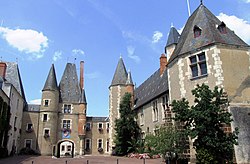
Château de Dun-sur-Auron
Dun-sur-Auron Castle
Dun-sur-Auron
Access
No visits on recordNo opening hours or ticketing found
- Where
- Dun-sur-Auron
To make a day of it
Open within 20 km
Sleep nearby
This week in the agenda
Château de Dun-sur-Auron stands in Dun-sur-Auron (Cher), in the Centre-Val de Loire region of France. The building is listed as a historic monument (dating recorded in the Mérimée database: first quarter of the 13th century, 14th century, 15th century). No visits are on record for this building.
The castle of Dun-sur-Auron centers on a clock tower, formerly a fortified gateway from the thirteenth century. Built as part of the town's second defensive system, it served as the main entrance before losing that function when a new fortified enclosure was constructed a century later. The structure underwent significant alterations in the late Middle Ages, notably the addition of a spiral staircase in the fifteenth century. Now converted into a museum, the site preserves the successive transformations of the fortress, from its medieval origins through its administrative and judicial roles in later periods.
What to know
- The site operates as a museum; check hours and access conditions before visiting.
- The tower dates from the early thirteenth century and was entirely reworked in the late fifteenth century.
- The castle served as prison and courthouse in the nineteenth century before its current transformation.
- The structure has been listed as a historical monument since 1913.
Where this château is
Dun-sur-Auron · Cher · Centre-Val de Loire
Loading the map…
This châteauChâteaux within 40 km
Address
Dun-sur-Auron, Cher
Directions open from wherever you are, by car or public transport.
- Period of construction
- first quarter of the 13th century, 14th century, 15th century
Base map © IGN, Géoplateforme
Frequently asked
- When was the Clock Tower built?
- The tower was built in the thirteenth century as a fortified access gate to the town of Dun.
- What was the castle used for in recent centuries?
- In the seventeenth century it housed administrative offices and a prison; in the nineteenth century it continued to serve as a prison and assizes hall.
- Why did the tower lose its function as a town gate?
- When a new fortification was built to the east in the fourteenth century, it ceased to control access to the town but retained its role as a belfry.
Something wrong here?
Tell us. Every report moves this entry up our verification queue.
Sources
Identity, location and official references from Wikidata and the Mérimée register.
- This entry in Markdown
- Wikidata Q22940560
- Mérimée PA00096788