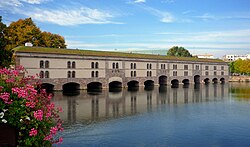
Manoir de Wangen
Wilwisheim
Access
No visits on recordNo opening hours or ticketing found
- Where
- Wilwisheim
To make a day of it
Open within 20 km
Manoir de Wangen stands in Wilwisheim (Bas-Rhin), in the Grand Est region of France. The building is registered as a historic monument (dating recorded in the Mérimée database: third quarter of the 17th century). No visits are on record for this building.
Built in 1669 by Jean-Louis Albert de Wangen, this manor house in Bas-Rhin retains its main residence in good condition, flanked by two perpendicular outbuildings, one of which contains a chapel. The complex, listed as a historical monument, reflects the architecture of Rhenish nobility in the third quarter of the 17th century. The large park that once surrounded it has disappeared following the property's conversion into an agricultural estate.
What to know
- The building and its outbuildings remain an active agricultural estate; access and visiting conditions should be verified with the owners.
- The protection covers the main residence, the facades and roofing of the outbuildings, the chapel, as well as the gate, fence, and surviving sections of the enclosure wall.
- The historical park no longer exists; only elements of the entrance gate and traces of the former fountain remain.
Where this château is
Wilwisheim · Bas-Rhin · Grand Est
Loading the map…
This châteauChâteaux within 40 km
Address
67270 Wilwisheim
Directions open from wherever you are, by car or public transport.
4.3 / 5from 4 Google reviews
- Period of construction
- third quarter of the 17th century
Base map © IGN, Géoplateforme
Itineraries
In pictures
Frequently asked
- When was Wangen Manor built?
- The manor was built in 1669 by Jean-Louis Albert de Wangen, a member of 17th-century Rhenish nobility.
- What is protected at Wangen Manor?
- The historical monument listing covers the main residence, the outbuildings with their chapel, the entrance gate, remnants of the enclosure wall and access bridge, as well as traces of the original fountain.
- Can visitors see the manor's park?
- The large park that originally surrounded the estate disappeared when the property was converted to agricultural use and no longer exists today.
Something wrong here?
Tell us. Every report moves this entry up our verification queue.
Sources
Identity, location and official references from Wikidata and the Mérimée register.
- This entry in Markdown
- Wikidata Q14627986
- Mérimée PA67000062
Within an hour’s drive
 Château de Dettwiller (Dettwiller Castle)Dettwiller · Bas-Rhin
 Château de Hochfelden (Hochfelden Castle)Hochfelden · Bas-Rhin
 Steinbourg ChâteauSteinbourg · Bas-Rhin
 Château de Bouxwiller (Bouxwiller Castle)Bouxwiller · Bas-Rhin
 Château du KochersbergNeugartheim-Ittlenheim · Bas-Rhin
 Château de Mittelhausen (Mittelhausen Castle)Wingersheim les Quatre Bans · Bas-Rhin