Rodenstatt
Schieder-Schwalenberg
Access
No visits on recordNo opening hours or ticketing found
- Where
- Schieder-Schwalenberg
To make a day of it
Open within 20 km
Rodenstatt stands in Schieder-Schwalenberg (Kreis Lippe), in North Rhine-Westphalia, Germany. The building is a listed Baudenkmal. No visits are on record for this building.
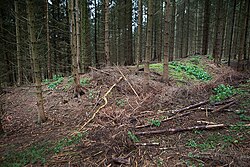
The Rodenstatt is a large Iron Age hillfort hidden in the forest east of the village of Brakelsiek, in the municipality of Schieder-Schwalenberg. The enclosure, originally covering around twelve hectares, lies on the eastern slope of the Adamsberg at 405 metres above sea level and ends to the northwest in a wooded escarpment known as the Rodenstätter Wand. Today only ground traces of the rampart remain, gradually levelled over time as stones were taken from it. Two excavation campaigns, in 1949 and 1966, uncovered evidence of a stone, timber and earth construction technique.
What to know
- The site lies in the forest about two kilometres east of Brakelsiek and is reached on foot.
- It consists of archaeological earthworks, with no standing buildings or reconstructions.
- The wooded, uneven terrain requires a reasonable level of fitness for the approach walk.
- The site is listed as a Kulturdenkmal in Germany.
- The northwestern corner of the enclosure was destroyed by a brickworks and pottery operating between 1781 and 1826.
Where this château is
Schieder-Schwalenberg · Kreis Lippe · Nordrhein-Westfalen
Loading the map…
This châteauChâteaux within 40 km
Address
Schieder-Schwalenberg, Kreis Lippe
Directions open from wherever you are, by car or public transport.
- Heritage status
- Kulturdenkmal in Deutschland
Base map © IGN, Géoplateforme
In pictures
Frequently asked
- What is the Rodenstatt?
- It is a former Iron Age hillfort, with surviving traces of its rampart in the forest near Brakelsiek.
- Can the Rodenstatt be visited freely?
- The site lies in the forest and is explored on foot, with no known visitor facilities.
- How old is the Rodenstatt?
- The enclosure dates from the Iron Age, according to archaeological analysis carried out on site.
- Why is part of the Rodenstatt missing?
- Its northwestern corner was destroyed by a brickworks and pottery operating between 1781 and 1826, and stones from the rampart were also removed over time.
- Have excavations taken place there?
- Yes, in 1949 and again in 1966, revealing a construction combining stone, timber and earth.
Something wrong here?
Tell us. Every report moves this entry up our verification queue.
Sources
Identity, location and official references from Wikidata and the Land's heritage lists.