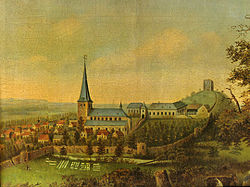
Burg Randerath
Randerath Castle
Heinsberg
Access
No visits on recordNo opening hours or ticketing found
- Where
- Heinsberg
To make a day of it
Open within 20 km
Burg Randerath stands in Heinsberg (Kreis Heinsberg), in North Rhine-Westphalia, Germany. No visits are on record for this building.
Burg Randerath stands in the Randerath district of Heinsberg, in North Rhine-Westphalia. Built on a motte around the year 900, it was the seat of the lords of Randerath, first recorded in 1157, before passing to the dukes of Jülich in 1392. Destroyed in 1542 and largely demolished in the eighteenth century, what remains today is a cellar building rebuilt in 1766, surrounded by traces of its former moat. The site is now in private hands and has been restored.
What to know
- The site is now privately owned, which limits access to the interior of the buildings.
- What visitors see mainly consists of the cellar building rebuilt in 1766, not the original medieval castle.
- The former moat that once surrounded the stronghold is still visible around the building.
- The site lies within the village of Randerath, part of the town of Heinsberg.
Where this château is
Heinsberg · Kreis Heinsberg · Nordrhein-Westfalen
Loading the map…
This châteauChâteaux within 40 km
Address
Heinsberg, Kreis Heinsberg
Directions open from wherever you are, by car or public transport.
- Heritage status
- Protection status unknown
Base map © IGN, Géoplateforme
In pictures
Frequently asked
- When was Burg Randerath built?
- The first stronghold was raised around the year 900 on a motte, while the building seen today results from a reconstruction in 1766.
- Who were the lords of Randerath?
- They were an important regional noble family, first recorded in 1157, who also held other properties such as Haus Beeck and Burg Bodendorf.
- Can Burg Randerath be visited?
- The site is privately owned and has been restored, which limits access to the interior of the buildings.
- What remains of the medieval fortress?
- Most of the original structures disappeared after the 1542 destruction and the eighteenth century demolitions; what remains is the 1766 cellar building, surrounded by traces of the former moat.
Something wrong here?
Tell us. Every report moves this entry up our verification queue.
Sources
Identity, location and official references from Wikidata and the Land's heritage lists.