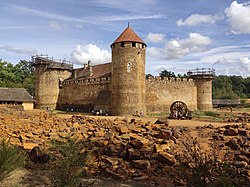
Château de la Cour de Fontenille
Brosses
Access
No visits on recordNo opening hours or ticketing found
- Where
- Brosses
To make a day of it
Château de la Cour de Fontenille stands in Brosses (Yonne), in the Bourgogne-Franche-Comté region of France. The building is registered as a historic monument (dating recorded in the Mérimée database: third quarter of the 18th century). The building is privately owned and no visits are on record.
The Château de la Cour de Fontenille, built in 1756 in Brosses, Yonne, is an 18th-century residence listed as a historical monument. The main building comprises three storeys topped by a four-sided roof, accompanied by outbuildings arranged asymmetrically and set within an intact agricultural estate. The property reflects local history, connected to the de Blosset family, prominent in regional Protestant life, and to the renowned Didot publishing family in the 20th century.
What to know
- The property, listed in 2013, encompasses the château, its terrace and adjoining parcels forming a complete ensemble preserved since the 18th century.
- The estate retains its original agricultural buildings, making it a rare witness to rural organisation of the period.
- Access and visiting conditions are not publicly documented; enquire with the local council or the owner.
Where this château is
Brosses · Yonne · Bourgogne-Franche-Comté
Loading the map…
This châteauChâteaux within 40 km
Address
Brosses, Yonne
Directions open from wherever you are, by car or public transport.
- Period of construction
- third quarter of the 18th century
Base map © IGN, Géoplateforme
Itineraries
Frequently asked
- When was the Château de la Cour de Fontenille built?
- The château dates from 1756 and was erected at the centre of a substantial agricultural estate in the late 18th century.
- Who lived at the Château de la Cour de Fontenille?
- The estate was home to the de Blosset family, notable for their role in Protestant history in the Burgundy-Nivernais region in the 16th century, and to the family of publisher Firmin Didot in the 20th century.
- Is the château open to visitors?
- The château has been listed as a historical monument since 2013, but public visiting arrangements are not formally established.
Something wrong here?
Tell us. Every report moves this entry up our verification queue.
Sources
Identity, location and official references from Wikidata and the Mérimée register.
- This entry in Markdown
- Wikidata Q22980740
- Mérimée PA89000054