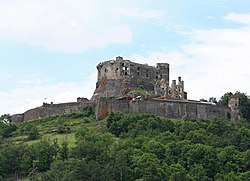
Château de Cropières
Cropières Castle
Raulhac
Access
No visits on recordNo opening hours or ticketing found
- Where
- Raulhac
To make a day of it
Open within 20 km
Château de Cropières stands in Raulhac (Cantal), in the Auvergne-Rhône-Alpes region of France. The building is listed as a historic monument (dating recorded in the Mérimée database: 13th century, 14th century, 17th century, 18th century). The building is privately owned and no visits are on record.
Cropières Castle in Raulhac developed through successive building phases from the 13th century into the 18th century. Originally a medieval stronghold, it evolved from the 1680s onward into an elegant residence, with a grand wing constructed around 1720 featuring a ceremonial hall. The castle arranges its buildings around a rectangular courtyard and retains, despite 20th-century losses, remnants of its various periods: thick walls from the original keep, 16th and 17th-century paintings and woodwork in its principal room.
What to know
- The castle is listed as a historic monument; visiting it remains subject to access conditions that should be verified directly.
- The building combines traces of a 13th-century fortress with improvements from the 1720s, notably a double-ramp staircase preceding the grand wing.
- The north wing suffered partial destruction after the First World War, removing nearly half its length and the chapel it contained.
- The principal room on the first floor retains hunting scenes painted in the 16th and 17th centuries and reflects Versailles-inspired decoration from the 1670s-1680s.
Where this château is
Raulhac · Cantal · Auvergne-Rhône-Alpes
Loading the map…
This châteauChâteaux within 40 km
Address
15800 Raulhac
Directions open from wherever you are, by car or public transport.
4.8 / 5from 4 Google reviews
- Period of construction
- 13th century, 14th century, 17th century, 18th century
Base map © IGN, Géoplateforme
Frequently asked
- When did the castle acquire its present appearance?
- The grand wing, which gives the castle its major character, was built around 1720. The reception apartments and ceremonial hall date from this period, while the north building retains older elements from the 13th century.
- What remains of the 13th-century fortification?
- The thick walls of the north-east building, particularly at the north-east corner, are considered the sole surviving remnant of the original keep. The primitive castle featured defensive elements progressively removed between 1626 and 1681.
- What was the purpose of the double-ramp staircase?
- This monumental staircase, built in the 18th century before the grand wing, serves as the main access to the reception hall. It extended the full length of the facade and continued by way of a terrace overlooking the former pleasure gardens.
Something wrong here?
Tell us. Every report moves this entry up our verification queue.
Sources
Identity, location and official references from Wikidata and the Mérimée register.
- This entry in Markdown
- Wikidata Q2192076
- Mérimée PA00093581
Within an hour’s drive
- Château de La Calsade (Calsade Castle)Badailhac · Cantal
 Château des Huttes (Huttes Castle)Polminhac · Cantal
 Château d'Olmet (Olmet Castle)Vic-sur-Cère · Cantal
 Château de Vixouze (Vixouze Castle)Polminhac · Cantal
 Chateau de MessilhacRaulhac · Cantal
 Château de Clavières (Clavières Castle)Polminhac · Cantal