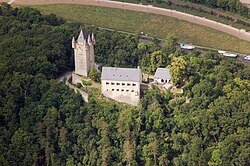
Langenau Castle
Obernhof
Access
No visits on recordNo opening hours or ticketing found
- Where
- Obernhof
To make a day of it
Schloss Langenau stands in Obernhof (Rhein-Lahn-Kreis), in Rhineland-Palatinate, Germany. The building is a listed Baudenkmal. No visits are on record for this building.
Schloss Langenau stands at the confluence of the Lahn and Gelbach rivers in Obernhof, built on the site of an old lowland fortress, an unusual form for this region. Its square Romanesque keep dates back to the 13th century, while the surrounding wall and the eight-metre shield wall flanked by two towers show Gothic features from the 14th or 15th centuries. The merchant and industrialist Marioth family converted the stronghold into a residential schloss at the end of the 17th century, giving it much of its present appearance. An early 20th-century restoration under Bodo Ebhardt added a further layer to its long architectural history.
Written from Langenau Castle
What to know
- The site lies in Obernhof, at the confluence of the Lahn and Gelbach rivers, in the Rhein-Lahn-Kreis district of Rhineland-Palatinate.
- The building is listed as a Kulturdenkmal in Germany.
- No verified information is available here regarding opening hours, admission fees, or access conditions.
- Visitors will find a complex combining a medieval Romanesque keep with a more residential character shaped by alterations in the 17th and early 20th centuries.
Where this château is
Obernhof · Rhein-Lahn-Kreis · Rheinland-Pfalz
Loading the map…
This châteauChâteaux within 40 km
Address
56379 Obernhof
Directions open from wherever you are, by car or public transport.
3.0 / 5from 4 Google reviews
- Heritage status
- Kulturdenkmal in Deutschland
Base map © IGN, Géoplateforme
In pictures
Frequently asked
- Where is Schloss Langenau located?
- It stands in Obernhof, in the Rhein-Lahn-Kreis district of Rhineland-Palatinate, at the confluence of the Lahn and Gelbach rivers.
- How old is Schloss Langenau?
- It was first recorded in 1243 in the will of Countess Mechthild von Sayn, who bequeathed it to the Archbishopric of Cologne, which then enfeoffed the von Langenau family with it.
- What medieval parts still survive?
- The square Romanesque keep dates from the 13th century, while the surrounding wall and the shield wall with its two towers date from the Gothic 14th or 15th centuries.
- Why is it called a Schloss rather than a Burg?
- The Marioth family converted the fortress into a residence between 1696 and 1698, giving it the manorial character reflected in the name Schloss.
Something wrong here?
Tell us. Every report moves this entry up our verification queue.
Sources
Identity, location and official references from Wikidata and the Land's heritage lists.