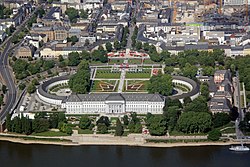
Schönbornslust
Koblenz
Access
No visits on recordNo opening hours or ticketing found
- Where
- Koblenz
To make a day of it
Schloss Schönbornslust stands in Koblenz (Koblenz), in Rhineland-Palatinate, Germany. Recorded dating: 18th century. No visits are on record for this building.
The Schloss Schönbornslust no longer exists: this baroque hunting lodge, built in Koblenz between 1748 and 1752 for the elector Franz Georg von Schönborn, vanished more than two centuries ago. Designed by Balthasar Neumann, his last completed palace, it consisted of a single wing with twenty-one window bays, set among fields and woods used for hunting hare, pheasant and fowl. Caught in the fighting when French revolutionary troops approached in 1794, it was left in ruins, sold off, and fully demolished in 1806. The site, in the Kesselheim district, is now covered by an industrial estate.
Written from Schönbornslust
What to know
- There is no building left to see: the Schloss was completely demolished in 1806.
- The former site lies in the Kesselheim district of Koblenz, now occupied by an industrial estate.
- Two auxiliary farm buildings survive near the former Maria Trost monastery nearby.
- No opening hours, admission fees or visitor facilities exist, as the monument no longer stands.
Where this château is
Koblenz · Koblenz · Rheinland-Pfalz
Loading the map…
This châteauChâteaux within 40 km
Address
Koblenz, Koblenz
Directions open from wherever you are, by car or public transport.
- Heritage status
- Protection status unknown
- Period of construction
- 18th century
Base map © IGN, Géoplateforme
In pictures
Frequently asked
- Can you visit Schloss Schönbornslust today?
- No, the palace was completely demolished in 1806 and no main building remains to visit.
- Why did Schloss Schönbornslust disappear?
- It was damaged in fighting in 1794 as French revolutionary troops advanced, then sold as a ruin and fully demolished in 1806.
- Who built Schloss Schönbornslust?
- The architect Balthasar Neumann designed it for Elector Franz Georg von Schönborn, with Johannes Seiz supervising construction, between 1748 and 1752.
- Is anything left of the estate today?
- Only two auxiliary farm buildings survive near the former Maria Trost monastery; the rest of the site is now an industrial area in Kesselheim.
Something wrong here?
Tell us. Every report moves this entry up our verification queue.
Sources
Identity, location and official references from Wikidata and the Land's heritage lists.