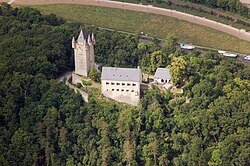
Karlsburg (Bad Ems)
Bad Ems
Access
No visits on recordNo opening hours or ticketing found
- Where
- Bad Ems
To make a day of it
Karlsburg (Bad Ems) stands in Bad Ems (Rhein-Lahn-Kreis), in Rhineland-Palatinate, Germany. The building is a listed Baudenkmal. No visits are on record for this building.
The Karlsburg in Bad Ems, in Rhineland-Palatinate, is a town palace also known as the Vier-Türme-Haus, the house of four towers. Its construction began in 1696 for field marshal Johann Karl von Thüngen, designed by court architect Johann Christoph Sebastiani, as lodging for his spa stays. Rebuilt as an elegant hotel in the 19th century, it welcomed European princes and artists, including Tsar Alexander II, who signed the Ems Ukaz here in 1876, banning the public use of the Ukrainian language in the Russian Empire. The building now houses a regional administrative office.
What to know
- The building is listed as a Kulturdenkmal in Germany.
- The palace is not a museum open to visitors; it houses administrative offices.
- A fire on the night of 3 July 2024 destroyed the roof structure.
- The building is best seen from the outside, as part of a walk through Bad Ems.
Where this château is
Bad Ems · Rhein-Lahn-Kreis · Rheinland-Pfalz
Loading the map…
This châteauChâteaux within 40 km
Address
Bad Ems, Rhein-Lahn-Kreis
Directions open from wherever you are, by car or public transport.
- Heritage status
- Kulturdenkmal in Deutschland
Base map © IGN, Géoplateforme
In pictures
Frequently asked
- Can visitors go inside the Karlsburg?
- No, the building currently houses administrative offices and is not open to visitors.
- Why is the Karlsburg also called Vier-Türme-Haus?
- Because of its four distinctive towers, which gave the building this nickname.
- What historical event took place at the Karlsburg?
- Tsar Alexander II signed the Ems Ukaz here in 1876, banning the public use of the Ukrainian language in the Russian Empire.
- Has the Karlsburg suffered recent damage?
- Yes, a fire on the night of 3 July 2024 destroyed the roof structure.
Something wrong here?
Tell us. Every report moves this entry up our verification queue.
Sources
Identity, location and official references from Wikidata and the Land's heritage lists.