Château de Môh
Môh Castle
Candes-Saint-Martin
Access
No visits on recordNo opening hours or ticketing found
- Where
- Candes-Saint-Martin
To make a day of it
Open within 20 km
Sleep nearby
This week in the agenda
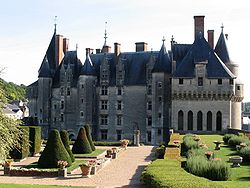
Château de Môh stands in Candes-Saint-Martin (Indre-et-Loire), in the Centre-Val de Loire region of France. The building is registered as a historic monument (dating recorded in the Mérimée database: 15th century, 17th century, 19th century). The building is privately owned and no visits are on record.
Château de Môh was a secondary residence of the Archbishops of Tours, built on a site continuously occupied since Roman times. The complex combines structures from the late 17th century (outbuildings), the 19th century (main house), and a medieval tower that was restored. The property is notable for its baroque terrace with three-sided projection and the Tower of Aubigny, which once defended Candes fortifications and overlooks the moated grounds.
What to know
- The main house retains 19th-century interior decoration, including a first-floor room with wallpaper depicting mythological scenes and period woodwork.
- Access passes through a courtyard surrounded by outbuildings, leading to the main residence and the Tower of Aubigny, which overlooks the moat.
- The façades, roofs, terrace with its retaining walls, and tower are protected as registered historic monuments since 1977.
Where this château is
Candes-Saint-Martin · Indre-et-Loire · Centre-Val de Loire
Loading the map…
This châteauChâteaux within 40 km
Address
Candes-Saint-Martin, Indre-et-Loire
Directions open from wherever you are, by car or public transport.
- Period of construction
- 15th century, 17th century, 19th century
Base map © IGN, Géoplateforme
Itineraries
Frequently asked
- Who built Château de Môh?
- It was a residence of the Church: the Archbishops of Tours used it as a secondary residence. The present structures date from the late 17th century and the 19th century, along with a restored medieval fortification tower.
- What can be seen inside the house?
- Rooms in the main building retain 19th-century decoration, including wallpapers with mythological motifs and period woodwork.
- Are there traces of the site's Roman past?
- The administrative record notes that a temple and Roman villa occupied this location before the château was built.
Something wrong here?
Tell us. Every report moves this entry up our verification queue.
Sources
Identity, location and official references from Wikidata and the Mérimée register.
- This entry in Markdown
- Wikidata Q22941289
- Mérimée PA00097610
Within an hour’s drive
 Château Vieux de CandesCandes-Saint-Martin · Indre-et-Loire
 Château de Montsoreau (Montsoreau Castle)Montsoreau · Maine-et-Loire
- Manoir de la ChauvellièreTurquant · Maine-et-Loire
- Manoir de la VignoleTurquant · Maine-et-Loire
- Château de la Fessardière (Fessardière Castle)Maine-et-Loire · Maine-et-Loire
- Château du Petit-Thouars (Petit-Thouars Castle)Saint-Germain-sur-Vienne · Indre-et-Loire