Château de Cascastel
Cascastel Castle
Cascastel-des-Corbières
Visit
Hours to be confirmed
You are leaving for the château’s own website
Tickets and prices
- Adult
- Free
Free for The visit to the Château is free (free participation towards costs)
- Where
- Cascastel-des-Corbières
Hours and prices not verified at the source yet.Check on the official website
To make a day of it
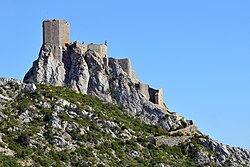
Château de Cascastel stands in Cascastel-des-Corbières (Aude), in the Occitanie region of France. The building is registered as a historic monument (dating recorded in the Mérimée database: 12th century, 17th century, 18th century). Admission is free. Its opening hours and prices have not been verified at the source yet.
In Cascastel-des-Corbières, a twelfth century tower overlooks the village, part of a larger complex built up in stages from the Middle Ages to the eighteenth century. The thick masonry, a stairway cut into the wall, and a former raised entrance all point to a structure built for defence. Inside, a salon decorated with eighteenth century plasterwork, commissioned by Marie-Thérèse de Ros, contrasts with the austerity of the medieval walls. The site overlooks the Berre river, once spanned by a bridge linking the château to its gardens.
Written from Château de Cascastel
What to know
- Access is from the village church square in Cascastel-des-Corbières.
- Parking is available at the Foyer Municipal for groups and hikers, as well as by the Berre quay or the Promenade des Jardins.
- The château is a listed historic monument, protected under two separate orders, one covering the tower and oven, the other the whole site.
- Part of the buildings, particularly south of the tower, are now in ruins.
- There is no admission fee according to available information.
Practical information
Prices
- Adult
- Free
Free for The visit to the Château is free (free participation towards costs)
- Visit duration
- Not verified
- Wheelchair access
- Not verified
- Dogs
- Not verified
- Parking
- Château on Place de l'Église; Foyer Municipal, Route d'Albas, for groups and hikers; Quai de la Berre or Promenade des Jardins
Where this château is
Cascastel-des-Corbières · Aude · Occitanie
Loading the map…
This châteauChâteaux within 40 km
Address
11360 Canton de Fabrezan
Directions open from wherever you are, by car or public transport.
5.0 / 5from 2 Google reviews
- Period of construction
- 12th century, 17th century, 18th century
Base map © IGN, Géoplateforme
Itineraries
In pictures
Frequently asked
- Château de Cascastel: how much is admission?
- Admission is free. Free for: the visit to the Château is free (free participation towards costs).
- Can you visit the château de Cascastel?
- Available information does not mention organised visiting hours; access is from the village church square.
- How old is the château de Cascastel?
- The tower dates from the twelfth century, with the rest of the buildings completed or altered up to the eighteenth century.
- Where can you park near the château?
- Parking is available at the Foyer Municipal on the route d'Albas, or near the Berre quay and the Promenade des Jardins.
- Is the château de Cascastel a listed historic monument?
- It is listed as a historic monument, under orders from 1948 for the tower and oven, and 2001 for the whole château.
Something wrong here?
Tell us. Every report moves this entry up our verification queue.
Sources
Identity, location and official references from Wikidata and the Mérimée register.
- This entry in Markdown
- Wikidata Q2968776
- Mérimée PA00102623
- Official website
Within an hour’s drive
 Château de Durban (Durban Castle)Durban-Corbières · Aude
 Château de Gléon (Gléon Castle)Villesèque-des-Corbières · Aude
 Château d'Aguilar (Aguilar Castle)Tuchan · Aude
- Château de Donos (Donos Castle)Thézan-des-Corbières · Aude
 Château de Villerouge-Termenès (Villerouge-Termenès Castle)Villerouge-Termenès · Aude
 Château de Périllos (Périllos Castle)Périllos · Pyrénées-Orientales