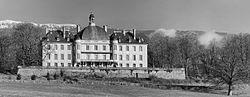
Château d'Eybens
Eybens Castle
Eybens
Access
Not open to visitors
The château is privately owned and is not freely open to the public.
Source: L'Agence Grenoble Alpes, courriel du 28 septembre 2026
- Where
- Eybens
To make a day of it
Open within 20 km
Château d'Eybens stands in Eybens (Isère), in the Auvergne-Rhône-Alpes region of France. The building is not open to visitors.
Set on a wooded knoll above the old village of Eybens, this castle combines a medieval keep, recorded before 1120, with a residence rebuilt around 1610. Several families lived here over the centuries, from the Briançon to the Chaper, including the Surville, and left behind a chapel later converted into living quarters where trompe l'oeil frescoes were rediscovered. The surrounding park now hosts an archery course.
Written from Château d'Eybens
What to know
- The castle stands on a wooded knoll that forms the park, reached on foot from the village center.
- No verified information is available on opening hours or admission fees.
- The park includes an archery course run by a local association, accessible from rue Paul Mistral.
- The interior frescoes and the former chapel are not necessarily open for casual visits.
Where this château is
Eybens · Isère · Auvergne-Rhône-Alpes
Loading the map…
This châteauChâteaux within 40 km
Address
Eybens, Isère
Directions open from wherever you are, by car or public transport.
- Heritage status
- Protection status unknown
Base map © IGN, Géoplateforme
In pictures
Frequently asked
- Can you visit the Château d'Eybens?
- No verified visiting conditions are available; only the park, with its archery course, is described as accessible.
- How old is the Château d'Eybens?
- The site is mentioned in documents predating 1120, though the current building likely dates from a rebuilding around 1610.
- Who lived in the Château d'Eybens?
- The Briançon, Chaponay and Surville families, followed by the Leclet, Perier and Chaper, lived there, and Christine of Savoy is said by some to have stayed there too.
- What remains of the medieval castle?
- A 13th-century keep was incorporated into the residence rebuilt in the 17th century.
Something wrong here?
Tell us. Every report moves this entry up our verification queue.
Sources
Identity, location and official references from Wikidata and the Mérimée register.