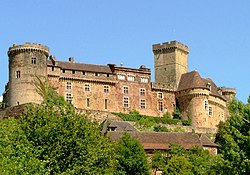
Tour du Capil
La Llagonne
Access
No visits on recordNo opening hours or ticketing found
- Where
- La Llagonne
Castrum de La Llagonne stands in La Llagonne (Pyrénées-Orientales), in the Occitanie region of France. The building is registered as a historic monument (dating recorded in the Mérimée database: 11th century, 13th century). No visits are on record for this building.
The castrum of La Llagonne is a fortified medieval settlement from around the 12th century, set in the high Pyrenees. The site contains the remains of a medieval defensive wall, a distinctive cylindrical tower, and the parish church of Saint-Vincent, whose walls still bear marks of its defensive role. Archaeological evidence points to much earlier habitation of the location, documented from the 10th century.
What to know
- The cylindrical tower and fortification remains are visible on the site, though specific access conditions and visiting arrangements are not detailed.
- The church of Saint-Vincent, an integral part of the protected castrum, features a single nave with blocked gun ports in its south wall.
- The site has been listed as a historical monument since 2010, encompassing the fortified enclosure, the Capil tower and the former cemetery.
Where this château is
La Llagonne · Pyrénées-Orientales · Occitanie
Loading the map…
This châteauChâteaux within 40 km
Address
5 Rue Jean Aspero, 66210 La Llagonne
Directions open from wherever you are, by car or public transport.
- Period of construction
- 11th century, 13th century
Base map © IGN, Géoplateforme
Frequently asked
- When was the castrum of La Llagonne built?
- The site has been inhabited since at least the 10th century, but the visible fortifications were constructed around the 12th century, with modifications continuing into the 13th century.
- What can be seen at the castrum today?
- The cylindrical tower with its defensive openings, the surviving sections of the enclosing wall, the tall gateway in the south presbytery facade and the church of Saint-Vincent with its fortification features are the most prominent remains.
- Why is the church fortified?
- The religious building bears gun ports and other defensive features because the church served as both refuge and strongpoint in the castle village's medieval defences.
Something wrong here?
Tell us. Every report moves this entry up our verification queue.
Sources
Identity, location and official references from Wikidata and the Mérimée register.
- This entry in Markdown
- Wikidata Q18004204
- Mérimée PA66000019
Within an hour’s drive
- Castell de SautóSauto · Pyrénées-Orientales
- Château de Caudiès-de-ConflentCaudiès-de-Conflent · Pyrénées-Orientales
 Castell de CreuMatemale · Pyrénées-Orientales
 Château de Sansa (Sansa Castle)Sansa · Pyrénées-Orientales
 Castell de NyòvolsCanaveilles · Pyrénées-Orientales
 Château d'Évol (Évol Castle)Évol · Pyrénées-Orientales