Turmhügel Wöhr
Wiesenttal
Access
No visits on recordNo opening hours or ticketing found
- Where
- Wiesenttal
To make a day of it
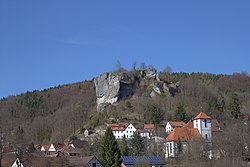
Turmhügel Wöhr stands in Wiesenttal (Landkreis Forchheim), in Bavaria, Germany. The building is a listed Baudenkmal. No visits are on record for this building.
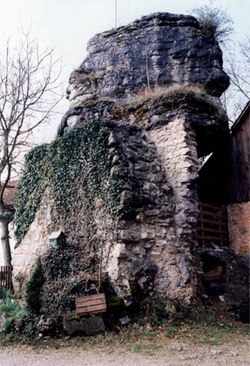
The Turmhügel Wöhr marks the site of a late medieval motte castle in the Wiesent valley near Streitberg, in Wiesenttal. It is also known locally as the Wall or Eppeleinsturm. Repeatedly destroyed and rebuilt, it belonged over time to minor noble families connected to the Lords of Schlüsselberg and later to the Bishopric of Bamberg. Today only a low earthen mound remains, on land now used for farming.
What to know
- The site lies in open farmland, about 200 metres southeast of the hamlet of Wöhr, and can be freely visited.
- No masonry survives, only a slight earthen mound roughly one metre high.
- The land is privately farmed, so visitors should stay on the edges rather than walking across it.
- There is no visitor infrastructure, signage, or facilities at the site.
- A visit is brief by nature, as this is an open-air remnant with free access and no set hours.
Where this château is
Wiesenttal · Landkreis Forchheim · Bayern
Loading the map…
This châteauChâteaux within 40 km
Address
Wiesenttal, Landkreis Forchheim
Directions open from wherever you are, by car or public transport.
- Heritage status
- Kulturdenkmal in Deutschland
Base map © IGN, Géoplateforme
In pictures
Frequently asked
- What remains of the Turmhügel Wöhr today?
- Only a slight earthen mound about one metre high remains, on land now used for farming.
- Can visitors access the site freely?
- Yes, the site is open to the public, though the surrounding land is privately farmed.
- Where exactly is the Turmhügel Wöhr located?
- It lies in the Wiesent valley near the hamlet of Wöhr, in the municipality of Wiesenttal in Bavaria.
- Is there a visible ruin at the Turmhügel Wöhr?
- No, it is mainly an archaeological site, as the original structure has long since vanished.
Something wrong here?
Tell us. Every report moves this entry up our verification queue.
Sources
Identity, location and official references from Wikidata and the Land's heritage lists.