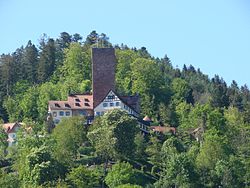
Ruine St. Ruprecht
Ehingen
Access
No visits on recordNo opening hours or ticketing found
- Where
- Ehingen
To make a day of it
Ruine St. Ruprecht stands in Ehingen (Alb-Donau-Kreis), in Baden-Württemberg, Germany. Recorded dating: 11th century. No visits are on record for this building.
The Ruine St. Ruprecht sits on a rocky spur 603 metres high, where the Marienthal valley meets the Große Lautertal, close to the Erbstetten district of Ehingen. Built in the 11th century, this former stronghold has never been firmly traced in historical documents, and its present name seems to come from a nearby plot of land first recorded in 1422. Only scattered wall remains survive from an enclosure that once measured roughly 80 by 50 metres and was cut off from the ridge by a large rock-hewn ditch. The site is an isolated ruin with no visitor facilities.
What to know
- The site is an open-air ruin reached on foot via a path up the rocky spur.
- Only wall fragments remain, with no roofed structure or museum space.
- There are no set opening hours or admission fees, as the site is freely accessible.
- The approach involves some physical effort due to the terrain and the rock-cut ditch.
- No accessibility facilities or dedicated parking are known to exist.
Where this château is
Ehingen · Alb-Donau-Kreis · Baden-Württemberg
Loading the map…
This châteauChâteaux within 40 km
Address
Unnamed Road, 89584, Ehingen (Donau)
Directions open from wherever you are, by car or public transport.
3.4 / 5from 12 Google reviews
- Heritage status
- Protection status unknown
- Period of construction
- 11th century
Base map © IGN, Géoplateforme
In pictures
Frequently asked
- Where is the Ruine St. Ruprecht located?
- It stands on a rocky spur near Erbstetten, a district of Ehingen in the Alb-Donau-Kreis, Baden-Württemberg.
- How old is the Ruine St. Ruprecht?
- The original stronghold dates back to the 11th century, based on ceramic finds from the site.
- What remains to see today?
- Only wall fragments survive from the former enclosure, which once measured about 80 by 50 metres.
- Is the ruin freely accessible?
- Yes, it can be reached on foot with no set hours or fees, though there are no visitor facilities.
- Where does the name St. Ruprecht come from?
- It likely derives from a nearby plot of land recorded under that name in 1422, not from the castle's original name.
Something wrong here?
Tell us. Every report moves this entry up our verification queue.
Sources
Identity, location and official references from Wikidata and the Land's heritage lists.
Within an hour’s drive
 Ruine MonsbergEhingen · Alb-Donau-Kreis
 Ruine Wartstein (Württemberg)Erbstetten · Alb-Donau-Kreis
 Burg Reichenstein (Württemberg) (Reichenstein (Württemberg) Castle)Lauterach · Alb-Donau-Kreis
 SchülzburgAnhausen · Landkreis Reutlingen
 Ruine MaisenburgHayingen · Landkreis Reutlingen
 Ruine RechtensteinRechtenstein · Alb-Donau-Kreis