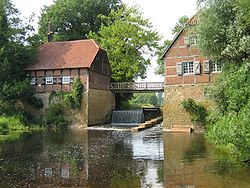
Burg Sassenberg
Sassenberg Castle
Sassenberg
Access
No visits on recordNo opening hours or ticketing found
- Where
- Sassenberg
To make a day of it
Burg Sassenberg stands in Sassenberg (Kreis Warendorf), in North Rhine-Westphalia, Germany. The building is a listed Baudenkmal. No visits are on record for this building.
Burg Sassenberg once stood on a cluster of islands surrounded by moats fed by the river Hessel, serving as a fortified seat of the prince-bishops of Münster. First recorded in 1305, the medieval stronghold was largely swept away by demolitions in the 18th and 19th centuries, so little of the original structure survives today. The site still recalls the grand baroque palace commissioned by Prince-Bishop Friedrich Christian von Plettenberg and later occupied by Clemens August of Bavaria. Nearby meadows, remnants of the former princely garden, host one of Germany's few remaining populations of the strictly protected snake's head fritillary.
What to know
- Only scattered remains of the old Burg and the later baroque Schloss survive today.
- The site is listed as a Baudenkmal in North Rhine-Westphalia.
- The fritillary meadows, in bloom in spring, lie within the former princely garden next to the site.
- No verified information is available regarding opening hours, admission fees or organised access.
Where this château is
Sassenberg · Kreis Warendorf · Nordrhein-Westfalen
Loading the map…
This châteauChâteaux within 40 km
Address
Sassenberg, Kreis Warendorf
Directions open from wherever you are, by car or public transport.
- Heritage status
- Baudenkmal in Nordrhein-Westfalen
Base map © IGN, Géoplateforme
Frequently asked
- Can Burg Sassenberg still be visited today?
- Only limited remains survive of the fortress and the later palace, most of the buildings having been demolished during the 18th and 19th centuries.
- Who built the Sassenberg palace?
- The large baroque palace was commissioned from 1698 by Prince-Bishop Friedrich Christian von Plettenberg of Münster, on the site of an earlier episcopal stronghold.
- Why is Sassenberg known for its flowers?
- The former princely garden now contains meadows where the rare, protected snake's head fritillary still grows.
- How old is the fortress at Sassenberg?
- The site is first documented in 1305, though earlier traces, including a motte, point to an older medieval origin.
Something wrong here?
Tell us. Every report moves this entry up our verification queue.
Sources
Identity, location and official references from Wikidata and the Land's heritage lists.